The week the air turns is the week the wardrobe asks the most of you. Mornings are cool enough for sleeves. Afternoons still carry the warmth of a season not quite finished. A transitional capsule wardrobe is not about owning less for the sake of restraint. It is about owning pieces that work harder, layer more naturally, and carry you through the weeks when the weather cannot make up its mind.
The principle is simple. Five to seven pieces, each one chosen for its ability to stand alone and sit beneath or above another. Texture does the work that weight cannot. Structure replaces insulation. And every piece earns its place by pairing with at least two others in the rotation.
The foundation: something that holds its shape
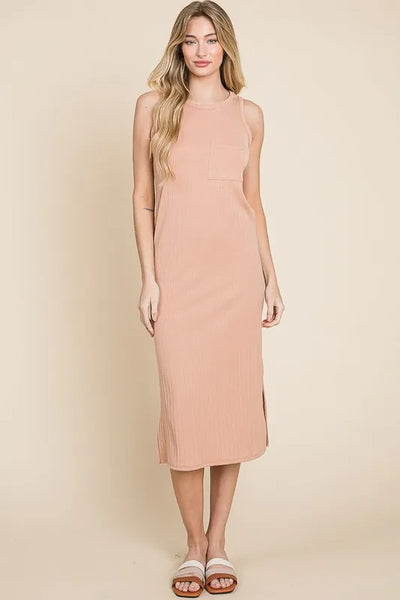
Every capsule starts with a piece that does not need a layer to look finished. A ribbed knit midi dress sits close to the body without clinging, and its structure means you can wear it on its own one day and under a blazer the next. The key is density. A fine rib holds warmth without bulk, and a midi length covers enough skin to feel appropriate when the temperature dips.
Look for a fabric with some weight to it. Thin jersey folds and wrinkles under layers. A denser knit keeps its line, which matters when you are building outward from it.
The structure: a piece that defines the silhouette
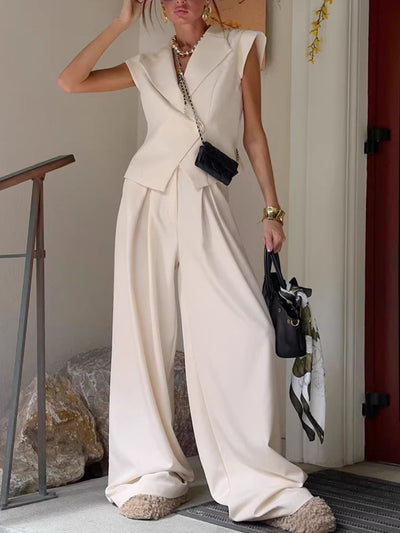
A capsule needs at least one piece with architectural intent. A blazer and wide-leg trouser set does this work. Worn together, it reads as a suit. Worn apart, the blazer becomes a layering piece over a dress or knit, and the trousers pair with anything soft. This is the quiet power of a set. Two pieces, three outfits, each one suited to a different temperature and occasion.
Choose a single-button closure over double-breasted for transitional weather. It keeps the blazer open and breathable when the afternoon warms, but structured enough to close when the evening cools. The trousers should have enough width to move with you but not so much that they overwhelm a smaller frame.
The ease: something that moves
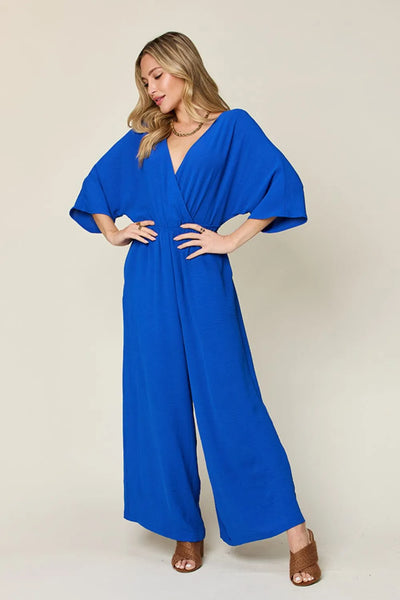
Not every piece in a capsule needs structure. One piece should bring ease. A surplice jumpsuit with a wide leg does this. The draped neckline softens the blazer's sharpness when worn beneath it, and on its own, it reads as an effortless single piece for a day that shifts from desk to evening without a change.
The pockets matter more than they should. A jumpsuit with pockets frees you from carrying a bag when the walk is short, and the wide leg means the silhouette holds whether you pair it with flats or heels.
The texture: weight without warmth
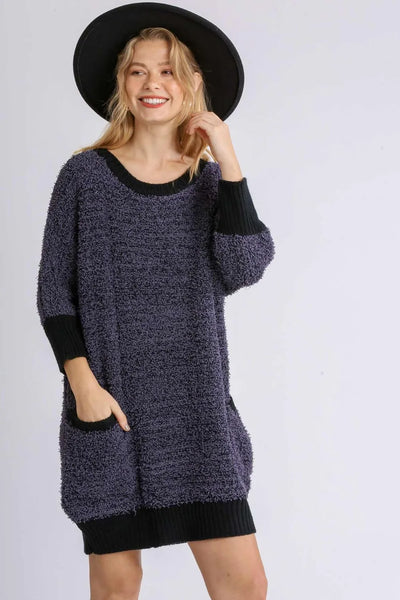
Transitional dressing lives in the space between summer's cottons and winter's wools. A sweater dress with a ribbed hem and three-quarter sleeves occupies that space. The knit gives weight and presence without the heat of a full wool, and the three-quarter sleeve is the most adaptable sleeve length in a transitional wardrobe. It covers enough for a cool morning and rolls easily when the day warms.
Pockets are not a detail. They are the difference between a piece you wear once a week and one you reach for every morning.
The print: one piece that carries the season
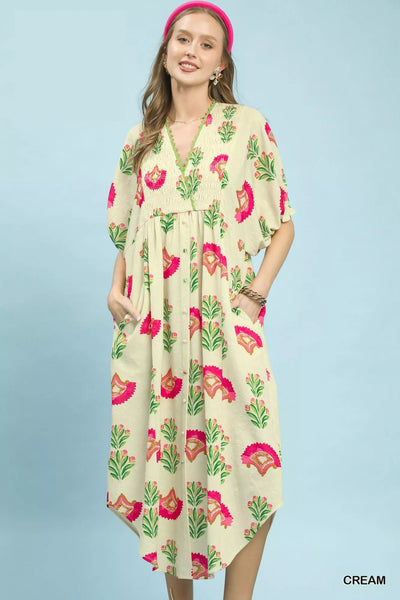
A capsule of solids is safe, but one piece with a print gives the wardrobe a focal point. An abstract print midi dress with a smocked bodice and pockets does the work of a statement without shouting. The print carries visual interest through the plain pieces around it, and the smocked bodice gives shape without a belt.
Wear it alone on the warmest transitional days. Layer the blazer over it when the morning is sharp. The print holds its own against the structure, which is the test of a good pattern.
Putting the capsule together
Five pieces. The ribbed dress as foundation. The blazer set as structure. The jumpsuit for ease. The sweater dress for texture. The printed midi for interest. Each one pairs with at least two others, which gives you fifteen distinct combinations before you repeat. That is a month of dressing from five pieces, and none of it feels like a uniform.
The measure of a good capsule is not how few pieces it contains. It is how many mornings you open the closet and know immediately what to wear. When every piece works with every other, the decision makes itself. That is the point. Not restraint, but ease.